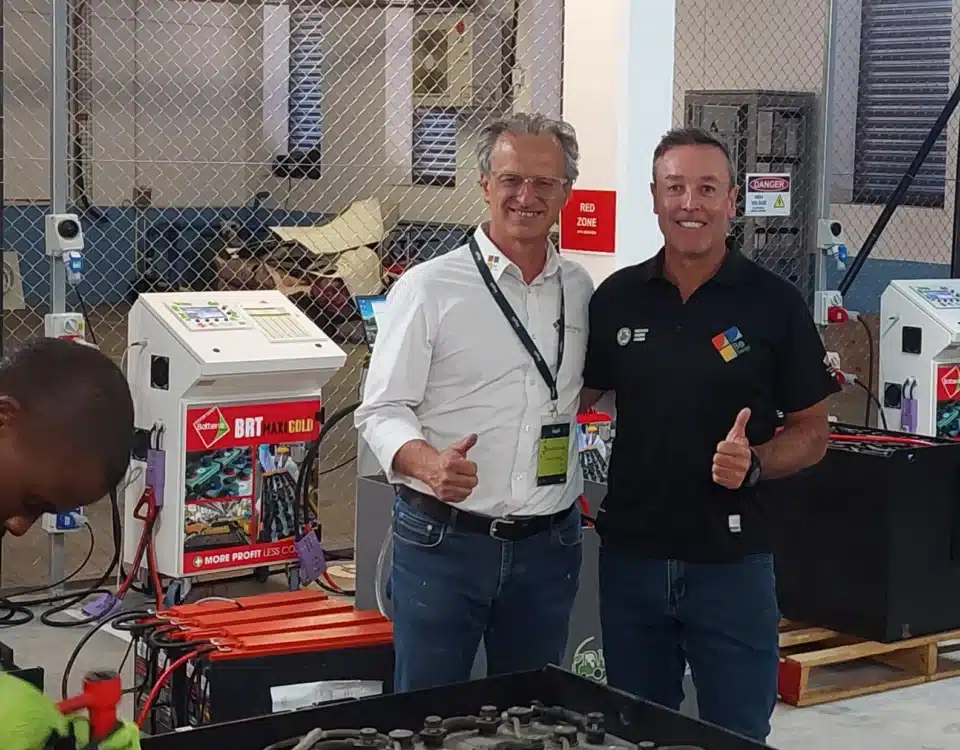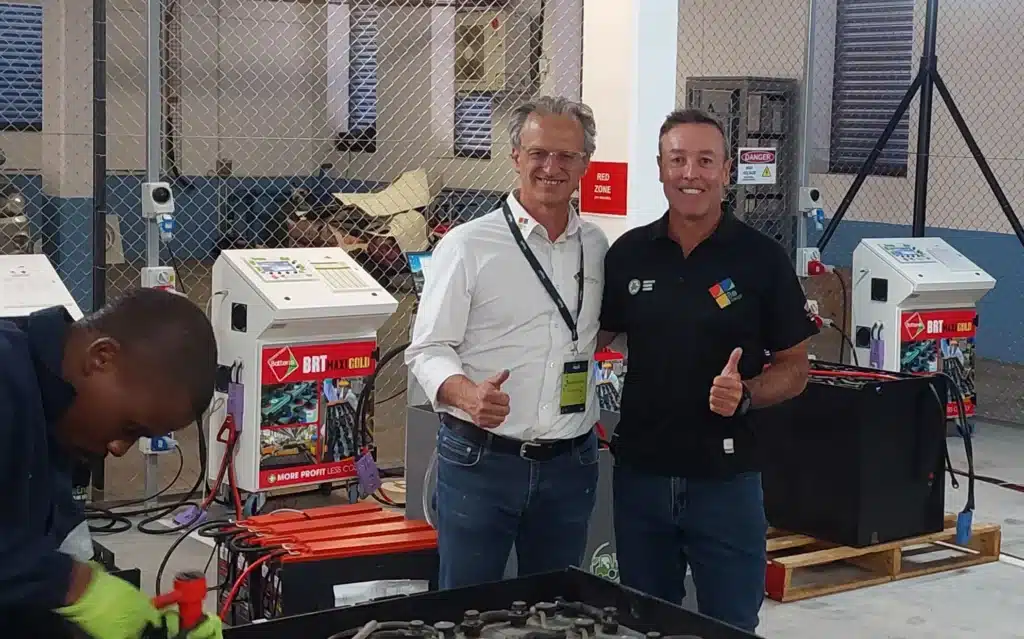


Be Energy South Africa is here!
7 July 2025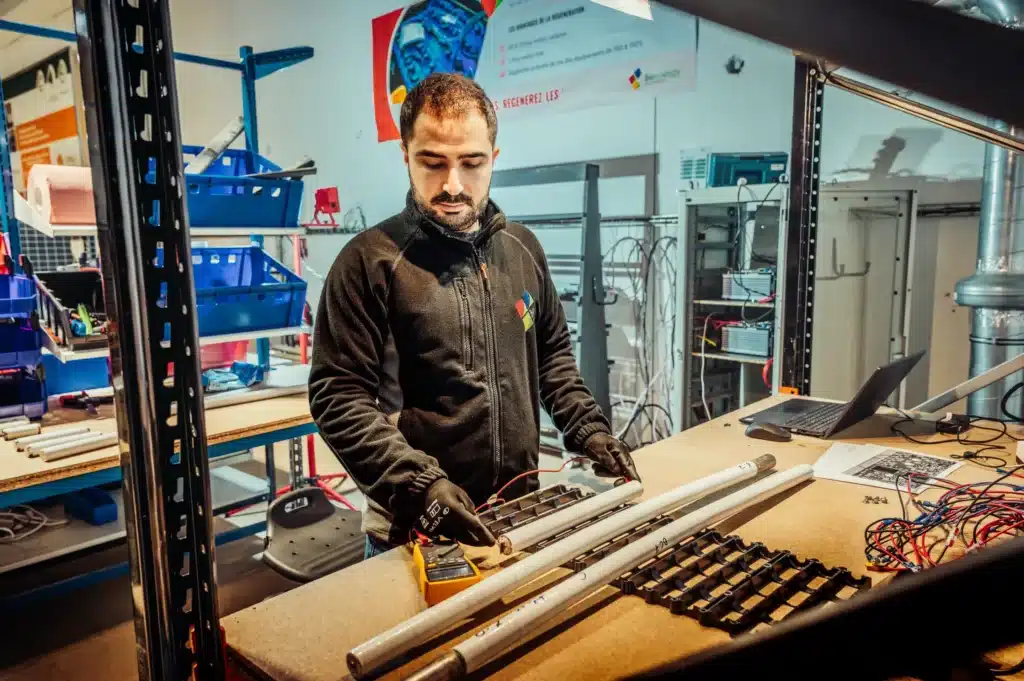
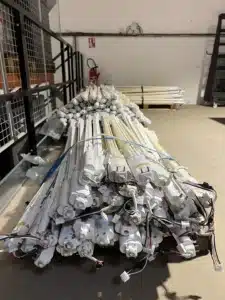
Be Energy workshop dedicated to the industrial regeneration of NiMH modules from JCDecaux's street furniture fleet.
Be Energy has signed an industrial contract with JCDecaux for the regeneration of NiMH batteries used in autonomous street furniture. To meet these large-scale needs, a dedicated space has been created in our workshops, equipped with a custom-built proprietary line capable of processing 60 NiMH modules simultaneously every 24 hours.
Each module is controlled individually with voltage, current, temperature, and impedance monitoring, ensuring accurate and safe regeneration. This approach restores electrochemical performance and extends the life of the modules.
A Dedicated Facility for Stationary NiMH Battery Regeneration
To handle the volumes supplied by JCDecaux, Be Energy deployed a proprietary facility specifically designed for stationary NiMH module regeneration.
This technical line features:
-
60 independent channels operating in parallel
-
Processing capacity of 60 NiMH modules every 24 hours
-
Per-channel voltage handling up to 20 V
-
Pulse injection capacity up to 100 A per channel
Each module undergoes individualized control, with precise monitoring of voltage, current, temperature, and impedance throughout the process.
This level of control allows Be Energy to correct common NiMH battery aging phenomena, including increased internal resistance, capacity imbalances between cells, memory effect, internal crystallization, and voltage drifts during charge and discharge cycles.
Industrial Process for Urban Furniture NiMH Pack Regeneration
Batteries are processed within a structured industrial workflow. Packs are first dismantled to extract the NiMH modules, which are then measured individually for voltage, internal resistance, and remaining capacity.
Modules are next processed on the high-intensity pulsed regeneration line, where controlled charge and discharge cycles, specifically adapted to NiMH chemistry, are applied. Following this, a electrochemical stabilization and requalification step validates restored performance.
Modules are then regrouped to rebuild homogeneous, balanced packs, optimized for the constraints of autonomous urban furniture. The reconstructed packs provide consistent and stable performance for immediate field deployment.
Closed-Loop Logistics Enabled by Machine Capacity
The system operates on a closed-loop principle. Used packs are sent to Be Energy’s facility, where NiMH modules are regenerated at industrial cadence — 60 modules per day. Reconditioned packs are then shipped according to the needs of field teams.
This organization ensures continuous availability of operational batteries, while significantly reducing reliance on new pack purchases.
Economic Benefits and Reduced Environmental Impact
NiMH battery regeneration enables:
-
Significant extension of the useful life of stationary batteries
-
Reduction of new pack purchases
-
Decreased logistics and supply chain flows
-
Lower end-of-life battery waste volumes
Avoiding the production of new NiMH batteries — which is resource- and energy-intensive — provides a major lever for carbon footprint reduction.
Industrial-Scale NiMH Regeneration for Urban Fleets
This partnership demonstrates that an industrial electrochemical engineering approach, combined with a high-intensity multi-channel line and closed-loop logistics, enables NiMH battery regeneration at the scale of a complete urban fleet.
NiMH regeneration thus becomes a credible industrial solution for the energy maintenance of urban infrastructure.
In Brief
-
Industrial regeneration of stationary NiMH batteries for JCDecaux urban furniture
-
Proprietary facility: 60 independent channels
-
Processing capacity: 60 modules every 24 hours
-
Per-channel control: 20 V and 100 A pulsed injection
-
Individual monitoring: voltage, current, temperature, impedance
-
Correction of NiMH aging phenomena
-
Full process: dismantling, diagnostics, pulsed regeneration, requalification, pack reconstruction
-
Closed-loop logistics ensuring continuous battery availability
-
Reduced new pack purchases, logistics costs, and waste
-
Significant reduction of carbon footprint associated with new battery production